Clean Air.
More
Move-Ins.
The data behind why air quality is affecting your occupancy rate, your staff retention, and your residents’ health — and what to do about it.
What’s Inside
Rensair Core i.
Rensair is a Smart Demand Control Ventilation (SDCV) system — it measures PM2.5, VOCs, temperature, and humidity in real time and controls air quality at the source. Unlike standard DCV systems that only monitor CO₂, Rensair measures what actually determines what people are breathing. Place it in your dining room, common areas, memory care hallways. Families can see it — and that visibility is part of the strategy. View certifications →
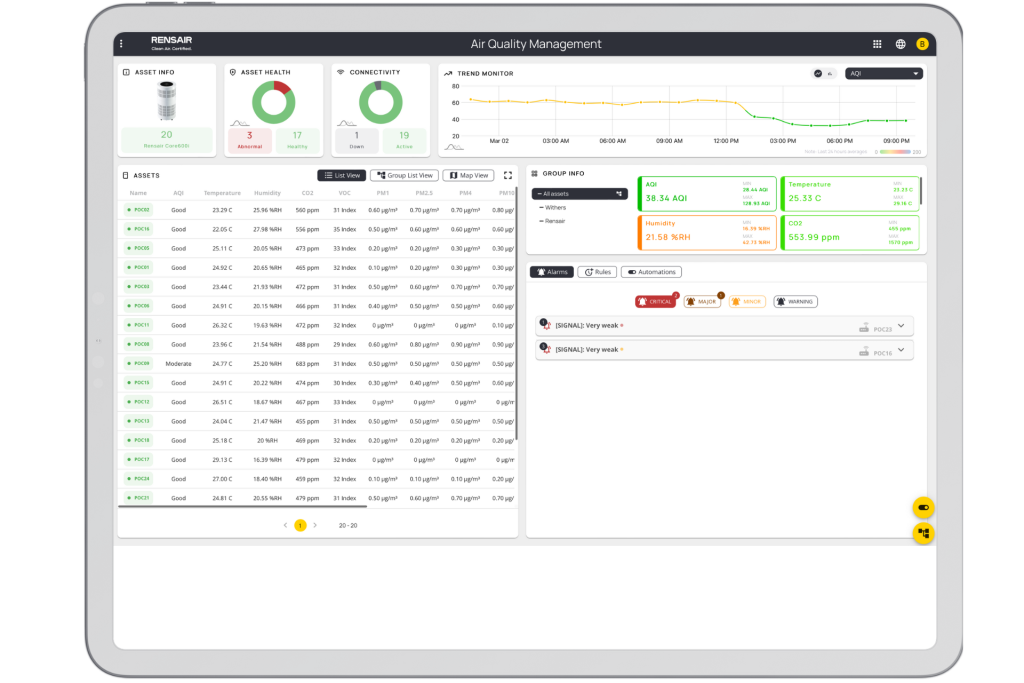
Show families the data. Every tour.
Rensair Cloud gives you a live dashboard of every air quality metric in every room. The operators converting at the highest rates are pulling this up on a tablet during tours. Families see a number. The conversation about smell ends before it starts.
Right now, families are forming an opinion about your community before the tour guide has said a word. In a study of 273,000 senior living reviews, cleanliness and odor were the single most cited topic — appearing in 25% of all reviews. That opinion is shaping your conversion rate every single day. With the industry averaging a 23.7% tour-to-move-in conversion rate (Bild & Co, 2024), a two-point improvement across a 100-facility portfolio adds approximately $29M in annual revenue at steady state. The gap between that number and your current performance may be a smell problem. Operators who have deployed live IAQ monitoring are already showing families the Rensair Cloud dashboard during tours — turning a liability into a selling point. The question is whether you’re on the right side of it.
“Close to 25% of all senior living online reviews mention cleanliness and odors — making it the single most cited topic across 273,000 reviews. ‘The presence of odors often serves as a proxy for quality and rigor, particularly during sales tours.’”
— Seniorly + Skypoint, 2023 analysis of 273,000 senior living web reviews
The senior living tour is decided in the first 90 seconds. Families have made their first impression before they’ve seen the dining room, met the care team, or reviewed the activity calendar. That impression is formed from what they see, feel — and smell. Yet the 23.7% industry-average tour-to-move-in conversion rate (Bild & Co, 2024) leaves significant room for improvement. In a 120-unit community running 20 tours per month, moving that conversion rate from 20% to 22% means 0.4 additional move-ins per month — and with a 22-month average length of stay (NCAL), that compounds to nearly 9 additional occupied beds at steady state. At a median monthly rate of $6,200 (AHCA/NCAL), that is roughly $55,800 in added monthly revenue from a 2-point conversion improvement alone.
The core problem is one of familiarity. Staff who work in a facility daily adapt to its air quality. But a prospective resident’s family member, walking in for the first time, has no such adaptation. Volatile organic compounds (VOCs) from cleaning products, kitchen activity, and aging HVAC systems accumulate gradually and invisibly. Residents and staff adapt. Prospects don’t — and they rarely say why they didn’t call back. With national assisted living occupancy at approximately 86% (NIC MAP, 2025), every converted tour has outsized portfolio impact.
Rensair addresses this at the source. HEPA H13 filtration captures PM2.5, PM10, and VOCs — the compounds responsible for odor and poor air quality perception. Germicidal UVC neutralizes airborne biological contaminants as they pass through the filtration chamber. The result is measurably cleaner air that you can verify in real time through the Rensair Cloud IAQ dashboard — and show to every prospect who walks through your door.
The Verification Advantage
During a tour, pull up the Rensair Cloud dashboard on a tablet. Show the prospective resident’s family member current PM2.5 and VOC readings — live, timestamped, in plain language. 96% of families report that cleanliness is “important or extremely important” when choosing a senior living community (Ecolab). Most facilities can assert this. Rensair-equipped facilities can prove it. And 9 in 10 Americans link cleanliness directly with level of care provided (Ecolab) — meaning the air quality conversation is simultaneously a care quality conversation.
Staff turnover is one of the most costly operational challenges in senior living. At 42–47% annual turnover for direct care workers (LeadingAge 2025), a 120-unit community replacing 10–15 caregivers per year is absorbing $35,000–$75,000 in replacement costs alone (Synkwise estimates) — before accounting for the quality-of-care disruption that drives resident dissatisfaction and, in some cases, voluntary move-outs. With a median assisted living monthly rate of $6,200 (AHCA/NCAL) and an average length of stay of 22 months (NCAL), each preventable move-out forfeits roughly $136,400 in revenue. Respiratory infections are one preventable driver of this cycle. Operators who have deployed continuous HEPA H13 filtration in common areas are documenting lower respiratory incident rates and using that data with families and surveyors. The question is whether you’re on the right side of it.
When a resident develops a respiratory illness from an airborne pathogen, the cascade is predictable: increased care needs, family concern, potential hospitalization, and — in serious cases — a move to higher-acuity care. When a staff member calls out sick, you’re absorbing that absence with overtime, agency fill, or schedule compression — compounding burnout and accelerating the next departure.
68% of senior living residents have existing respiratory conditions — COPD, asthma, or compromised immune function — that make them disproportionately vulnerable to airborne particulate matter and pathogens. Continuous HEPA H13 + UVC filtration reduces the concentration of airborne PM2.5 and pathogens in common areas 24/7, providing a persistent layer of protection that supplements — not replaces — clinical infection control protocols.
There is a second financial dimension that is rarely modeled: healthier residents stay longer. With a median assisted living length of stay of 22 months (NCAL) and a national median monthly rate of $6,200 (AHCA/NCAL), a single respiratory hospitalization that accelerates a move to higher-acuity care forfeits an average of $136,400 in revenue per resident. Across a 100-facility portfolio, reducing involuntary move-outs driven by preventable health decline by even 1% per facility represents millions in retained revenue — revenue that never shows up in a traditional infection control ROI model, but is directly addressable through cleaner air. Operators who have deployed continuous HEPA H13 filtration are beginning to document lower respiratory incident rates and using that data in family communications, regulatory filings, and competitive positioning.
The IAQ Documentation Advantage
Rensair Cloud provides continuous, timestamped IAQ logs — PM2.5, VOC, and temperature — 24 hours a day. This data record supports:
- CMS survey readiness and state licensing documentation
- Infection Prevention and Control (IPCP) program evidence
- Family trust conversations: “Here is our air quality data for the past 30 days.”
- Internal quality reporting to regional and corporate leadership
What the Research Shows
Rensair’s clinical research program includes a peer-reviewed study examining airborne filtration and respiratory health outcomes. The technology has been independently validated by the Danish Technological Institute, IndoorScience (US independent lab), and deployed in NHS care settings in Liverpool — two of the more rigorous independent testing environments available. While study populations differ from senior living settings, the data demonstrates consistent efficacy in reducing airborne particulate exposure. View all certifications at rensair.com/certifications → Given that 68% of your residents carry existing respiratory diagnoses, the margin for airborne pathogen exposure is materially lower than in general population settings — which is precisely why hospital-grade filtration standards matter here.
Not all air quality metrics are created equal. Understanding which metrics to track — and which to treat with skepticism — will help you evaluate vendor claims, interpret your IAQ data, and communicate credibly with families, surveyors, and corporate leadership. With 96% of families calling cleanliness a critical selection criterion (Ecolab), this is not a technical discussion. It is a revenue discussion. Operators who can show a family live PM2.5 data on a tablet during a tour are having a fundamentally different sales conversation than those who cannot. The question is whether you’re on the right side of it.
| Metric | What It Measures | Relevant for Senior Living? | Rensair Monitors It? |
|---|---|---|---|
| PM2.5 | Fine particulate matter — dust, allergens, combustion particles, mold spores | ✓ YES — directly linked to respiratory health outcomes | ✓ YES (Rensair Cloud) |
| PM10 | Coarser particles — dust, pollen | ✓ YES | ✓ YES (Rensair Cloud) |
| VOC | Volatile organic compounds — odors, cleaning products, off-gassing | ✓ YES — primary driver of odor in senior living | ✓ YES (Rensair Cloud) |
| Temperature | Indoor thermal comfort | Moderate | ✓ YES (Rensair Cloud) |
| CO₂ | Carbon dioxide — the original air quality proxy, first metric measurable by early sensors | Limited — a useful indicator of ventilation rate, but does not measure PM2.5, VOC, or pathogen load | Not primary focus — Rensair optimizes for the metrics that directly affect resident health |
| Humidity | Relative humidity — affects mold and comfort | Moderate | Partial |
Why CO₂ Is Not the Right Metric
CO₂ became the default air quality metric for a straightforward reason: it was the first thing sensors could reliably measure. It remains a useful proxy for ventilation rate — elevated CO₂ can indicate that a space is under-ventilated. But ventilation rate is not air cleanliness. A facility can have perfectly normal CO₂ levels and still carry high concentrations of PM2.5, VOC, or airborne pathogens — exactly the compounds that pose the greatest risk to the 68% of residents with existing respiratory conditions (industry data) and that families sense during tours. CO₂ tells you how much air is moving. It does not tell you what is in that air. Rensair optimizes for PM2.5 and VOC: the metrics that directly determine what residents and staff are actually breathing.
Memory Care Note: Memory care units face air quality standards that are materially more stringent than general assisted living — closer to hospital-grade requirements. Residents in memory care have diminished ability to self-report discomfort, heightening the importance of continuous, verified air quality monitoring. For operators running memory care alongside assisted living, Rensair’s clinical-grade filtration is not an upgrade from the standard — it is the standard.
Communicating IAQ Data to Families
When a family asks “is the air quality good here?” most operators respond with assurance. Rensair-equipped operators respond with data. Pull up the Rensair Cloud dashboard — current PM2.5: 4 μg/m³, VOC: low, temperature: 72°F. WHO guideline PM2.5 limit: 15 μg/m³. Show the gap. That conversation closes more tours than any brochure — particularly at the 23.7% industry-average conversion rate (Bild & Co, 2024), where every percentage point of improvement has compounding value over a 22-month resident tenure.
“96% of families rate cleanliness as ‘important or extremely important’ when selecting a senior living community. The families asking about air quality during your tours are part of a much larger pattern. The ones who don’t ask are still noticing.”
— Ecolab consumer study
How Rensair Works
Rensair Core units are commercial-grade, portable air filtration units combining HEPA H13 filtration with germicidal UVC. Each unit processes the air in its zone continuously — capturing PM2.5, PM10, and VOCs while neutralizing airborne pathogens. Units are placed in common areas, corridors, and dining rooms. Installation requires no construction — Rensair’s team completes each facility in under 1 day. And because 68% of your residents carry existing respiratory diagnoses (industry data), the case for continuous, 24/7 filtration is not aspirational — it is clinical. Operators who deployed Rensair first are already using their 90-day IAQ data in regulatory filings, family conversations, and competitive sales — while competitors are still running on HVAC manufacturer claims. The question is whether you’re on the right side of it.
Captures 99.95% of particles ≥0.2μm — fine particulate matter, allergens, mold spores, and airborne viral particles. Medical-grade standard — the same specification used in hospital operating rooms. Independently certified by the Danish Technological Institute and IndoorScience (US independent lab). See certifications → Directly targets the PM2.5 and VOCs that drive odor perception and the negative impressions that suppress your 23.7% tour-to-move-in conversion rate (Bild & Co, 2024).
Neutralizes airborne pathogens — bacteria and viruses — that pass through the filtration chamber. Operates continuously, 24 hours a day, 7 days a week. Provides a persistent, verifiable layer of biological protection for a resident population where 9 in 10 Americans link cleanliness directly to quality of care (Ecolab).
Your 90-Day Pilot Roadmap
Rensair’s team walks your common areas and assesses unit placement. Baseline IAQ readings taken. No commitment required.
You receive a scoped proposal: unit count, placement map, expected IAQ improvement, and timeline.
One signature. No permits, no construction, no facilities overhaul.
Units installed with no disruption to residents or staff. Same-day operational.
Live PM2.5, VOC, and temperature data from day one. Show it on your next tour. The air quality speaks for itself.
The industry’s average tour-to-move-in conversion rate is 23.7% (Bild & Co, 2024). With a median assisted living length of stay of 22 months (NCAL) and a national median monthly rate of $6,200 (AHCA/NCAL), a 2-percentage-point improvement in conversion across a 100-facility portfolio adds approximately $29M in annual revenue at steady state. The air quality case isn’t just operational. It’s financial.
Schedule my free site visit and get my baseline IAQ data.
No cost. No commitment. Rensair’s team will walk your common areas, take baseline PM2.5 and VOC readings, and deliver a written IAQ assessment — so you know exactly what your air quality looks like before a prospect does.