Clean Air.
Better
Cap Rates.
How RIDEA portfolio owners are turning HVAC energy waste into portfolio equity — through a capital investment with a defined payback period and permanent NOI improvement.
What’s Inside
Rensair Core i.
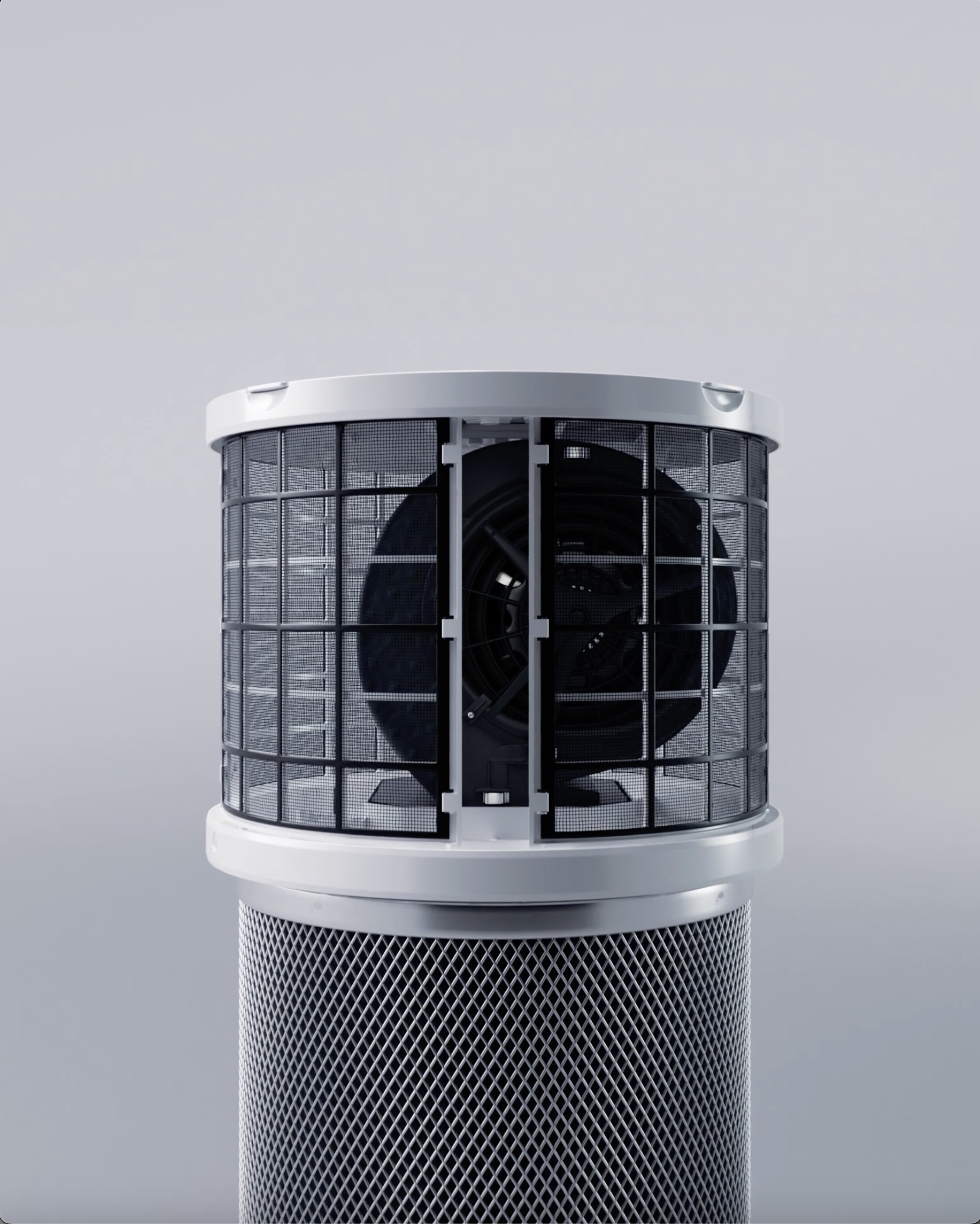
Rensair is a Smart Demand Control Ventilation (SDCV) system — measuring PM2.5, VOCs, temperature, and humidity in real time, not just CO₂. It controls air quality at the source. Deployed as a standalone unit — no HVAC replacement, no construction. Works with what you have.
Every facility. Every room. Live data.
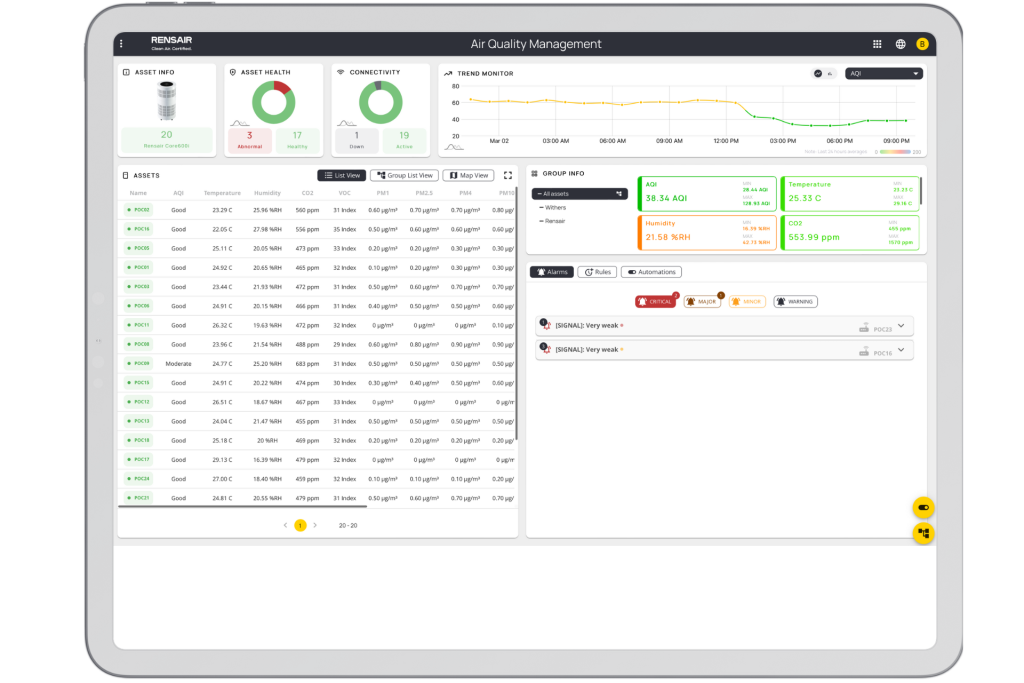
Rensair Cloud connects every unit across your portfolio into a single real-time dashboard — PM2.5, VOC, CO₂, temperature, and humidity, tracked by room, by facility, by region. Your asset managers see clean air the same way they see occupancy: as a number, trended over time, reportable to your board.
Right now, your HVAC system is operating as a cost center. For REITs under RIDEA structures, that’s not just an OpEx problem — it’s a cap rate problem. Every dollar of preventable HVAC spend is compressing your NOI, and at a 5% cap rate, that compression is worth 20x its face value in portfolio equity. HVAC is the largest controllable operating expense in senior living — typically 35–50% of total energy spend — and most RIDEA portfolios are leaving it unoptimized. The senior living REITs that moved earliest on HVAC optimization now have a verifiable cost advantage that compounds quarterly. The question is whether you’re on the right side of it.
| Portfolio Size | Annual Saving | Equity @ 5% Cap |
|---|---|---|
| 50 Facilities | $1,000,000 | $20,000,000 |
| 200 Facilities | $4,000,000 | $80,000,000 |
| 500 Facilities | $10,000,000 | $200,000,000 |
| 1,000 Facilities | $20,000,000 | $400,000,000 |
Why RIDEA changes everything: Under RIDEA, the REIT bears HVAC energy costs — not the operator. Every $1 of saving flows to NOI and, through the cap rate, becomes $20 of equity value at 5%.
The REIT Multiple Effect is the mechanism by which an operating expense reduction — HVAC energy spend — becomes an equity value creation event. It exists because of the cap rate relationship between NOI and asset value. REITs that have already modeled this are presenting it to investors as a capital efficiency story. The question is whether you’re on the right side of it.
The core principle: At a 5% cap rate, every $1 of permanent annual NOI improvement creates $20 of portfolio equity value. HVAC energy savings are permanent — they repeat every year from a one-time capital investment.
The capital investment in Rensair hardware is recovered through annual energy savings. The payback period (hardware CapEx ÷ $20K annual saving) tells you when break-even occurs. But the equity value creation begins on day one and continues permanently after payback.
The right question for a RIDEA CFO is not only “when do we break even?” but also “what does a permanent $20K/year income stream add to asset value?” Both questions matter. Both have clear answers.
| Question | Payback View | Equity View (RIDEA) |
|---|---|---|
| Primary metric | Cash payback period | Equity value per dollar invested |
| Annual benefit | $20K operating saving | $20K saving = $400K equity value |
| Portfolio view | Cost item per building | Portfolio equity event ($80M+) |
| How to calculate | Hardware CapEx ÷ $20K | Annual saving ÷ cap rate |
REIT CFOs and asset managers have several capital investment options for reducing HVAC energy spend. This chapter ranks them by accessibility, speed-to-savings, and NOI impact. Portfolio owners who have already deployed supplemental HVAC hardware are booking energy savings within 30 days of installation — while peers still in committee are absorbing those same costs. The question is whether you’re on the right side of it.
| Investment Lever | Upfront CapEx | Typical Saving | Payback Basis | Notes |
|---|---|---|---|---|
| Rensair Core + Cloud#1 Fastest Payback | Hardware purchase + annual Cloud license | 40% of common area HVAC spend (~$20K/yr avg.) | CapEx ÷ $20K annual saving (~20% floor · 24% portfolio avg · 38% case study high) | Supplemental hardware — no HVAC replacement. Day 30 energy savings report from Rensair’s Performance & Insights team. Savings validated independently. |
| Smart Thermostat / BMS Upgrade | $5K–$20K / facility | 10–15% HVAC saving | 3–8 years | Moderate capital. Good baseline, but leaves significant HVAC saving unrealized. |
| HVAC System Replacement | $50K–$200K+ / facility | 20–30% HVAC saving | 7–15+ years | High CapEx, long payback, operational disruption during install. |
| Solar / Onsite Generation | $200K–$1M+ / facility | Total energy offset | 8–20 years | Very high CapEx, permitting complexity, long payback. High ESG impact. |
Capital allocation insight: Rensair Core delivers the highest HVAC energy saving per dollar of CapEx invested — without disrupting existing HVAC infrastructure. The annual Rensair Cloud license maintains indoor air quality monitoring for the life of the hardware. The Rensair App tracks energy savings, verified via IPMVP.
Use this worksheet to calculate your portfolio’s payback period, annual saving, and equity value creation. Request hardware pricing from Rensair for the CapEx input fields. Every quarter this analysis sits unrun is a quarter of NOI compression you don’t have to absorb. REITs that have run this model are using it in investor presentations today. The question is whether you’re on the right side of it.
Verified IRR Range — Senior Living Deployments Rensair’s senior living portfolio delivers IRR across a verified range. ~20% IRR at the conservative floor. 24% average across all active senior living deployments. 38% realized IRR at our Central Michigan case study community (158-unit, IPMVP-verified, 15-year life). The range reflects facility size and HVAC baseline — every project is modeled individually. Energy savings are verified via IPMVP.
Get your custom portfolio payback model
Book a 30-minute call and walk away with a modeled NOI impact number, equity value estimate, and hardware payback timeline — built from your actual portfolio data.
Rensair recommends a 3-building hardware pilot before portfolio-wide capital deployment. This is exactly the framework the world’s largest senior living REIT used — a portfolio of more than 2,500 facilities — before committing to a full rollout. The pilot produces your own building-level energy data so the portfolio capital decision is made on evidence, not projections. The REIT that ran this pilot first is now deploying Rensair across its portfolio with IPMVP-verified savings data already in hand. The question is whether you’re on the right side of it.
What the pilot involves: A 5-step process: Site Visit, Proposal, Approval, Installation, and Activation. IPMVP-verified savings are documented within 90 days. Your finance team reviews verified data before the portfolio capital decision.
Pilot Guarantee: If Rensair delivers less than 80% of the projected savings target in the first three years, Rensair will rebate the difference. The risk of the capital decision is backed by our guarantee. Contact Rensair for full guarantee terms.
Get your pilot proposal and baseline IAQ data.
Schedule a 30-minute portfolio analysis call. You’ll receive a scoped pilot hardware proposal for 3 buildings — including projected NOI impact, payback period, and IPMVP verification timeline.
In May 2024, Rensair equipped common areas of a 158-unit, 168,000 ft² community in Central Michigan with 17 Core 360i devices and 3 Compact devices — covering 9 RTUs and closet furnaces. Submetering equipment was installed to monitor and verify energy consumption in real time.
Installation was completed under one day. No HVAC replacement, no construction, no operational disruption.
After 12 months, the community exceeded its savings target by $1,926 — delivering $23,426 in IPMVP-verified energy savings, well beyond the projected $21,500. The 38% IRR is based on 15 years expected equipment life with IPMVP-verified savings and conservative filter replacement assumptions.
The project also demonstrated IAQ resilience. During the June 2025 Canadian wildfire event — when outdoor PM2.5 exceeded 100 µg/m³ across the Midwest — indoor PM2.5 stayed at healthy levels throughout. When units activated at 7am, indoor PM2.5 dropped more than 50% in under one hour.
floor
average
case study