


HEPA vs UV Air Purifier: Differences Explained
Indoor air may look clean, but it can still contain dust, allergens, bacteria, and other harmful pollutants.
This is why air purifiers are important for healthier indoor spaces.
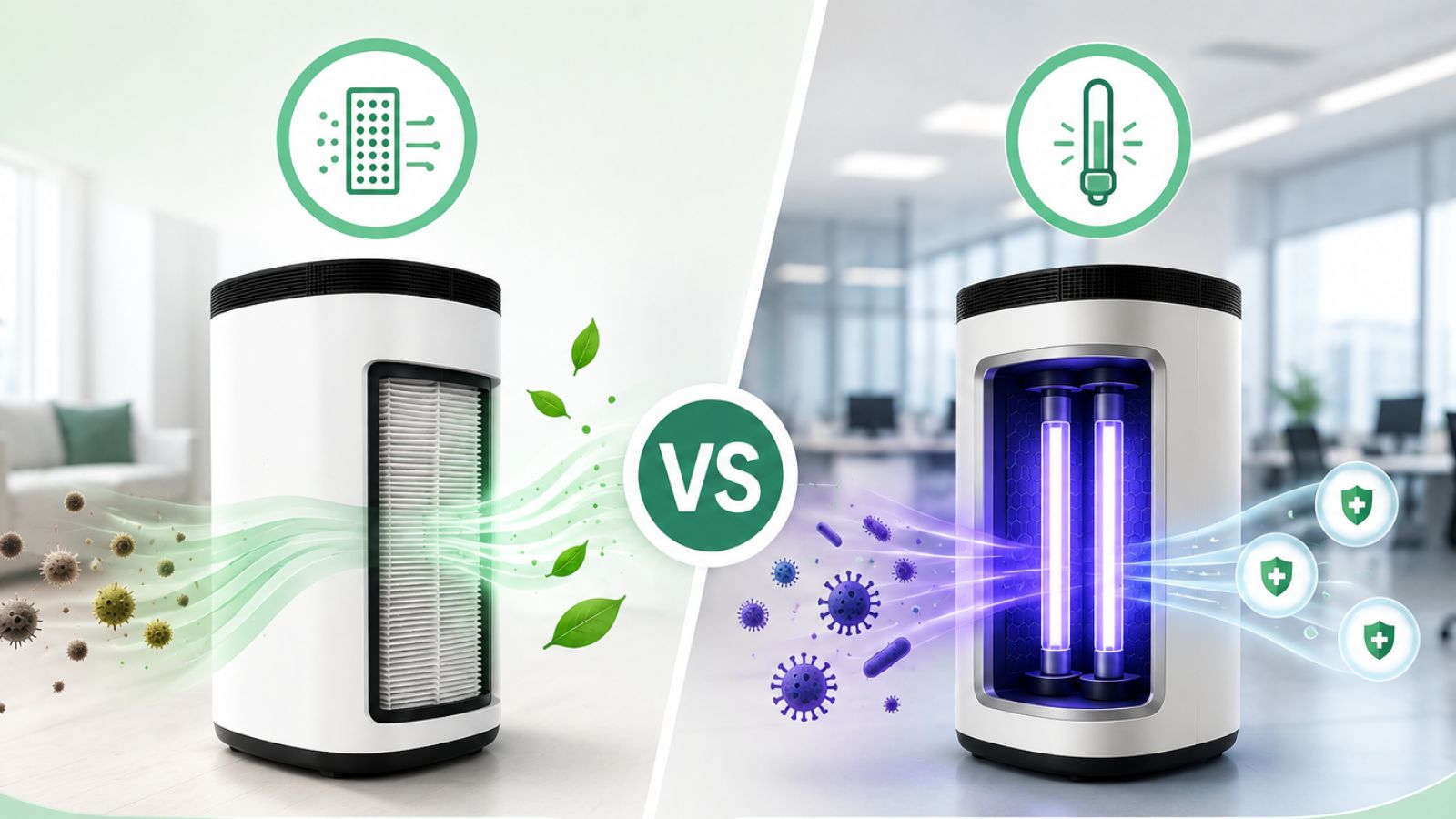
HEPA and UV-C are the two most common air purifier technologies. HEPA filters trap dust and fine particles, while UV-C light helps neutralise bacteria and viruses.
Understanding the difference between HEPA vs UV air purifier helps you choose the right solution for better indoor air quality.
What is a HEPA Air Purifier?
A HEPA (High-Efficiency Particulate Air) air purifier uses a specialised filter to trap harmful airborne particles and improve indoor air quality.
It is a device that uses a dense, pleated filter to trap at least 99.97% of airborne particles as small as 0.3 microns, including dust, pollen, pet dander, mold, and smoke.
How HEPA Works
- Air is pulled through a dense HEPA filter
- Microscopic particles get trapped inside the filter fibres
- Clean air is released back into the room
HEPA Air Purifier is Best For
- Allergies and asthma relief
- Removing indoor pollution
- Improving overall air quality
Modern systems like Rensair HEPA air purifiers go beyond basic filtration. They use medical-grade HEPA filters designed for high-performance environments such as offices and healthcare spaces.
Rensair air purifiers are built to:
- Deliver powerful air circulation
- Capture fine particles efficiently
- Maintain consistent indoor air quality in real-world conditions
What is a UV Air Purifier?
A UV (Ultraviolet) air purifier uses UV-C light to neutralise harmful microorganisms in the air.
How UV Works
- Air passes through a chamber with UV-C light
- The light damages the DNA of bacteria and viruses
- Microorganisms become inactive and cannot spread
A UV air purifier is Best For
- Reducing airborne infections
- Improving hygiene in shared spaces
- Supporting healthier indoor environments
Advanced systems like the Rensair Core Smart Air Purifier integrate UV-C technology with filtration.
This means:
- Airborne microbes are neutralised effectively
- Continuous air sanitisation in occupied spaces
- Suitable for offices, schools, and healthcare settings
HEPA vs UV-C Air Purifier: What Are The Differences
| Feature | HEPA Air Purifier | UV-C Air Purifier |
| Working Method | Uses physical filtration with a dense, pleated mesh filter to trap airborne particles. | Uses UV-C light sterilisation to destroy or deactivate microorganisms. |
| Main Targets | Dust, pollen, pet dander, smoke, mold spores, and other fine particles. | Bacteria, viruses, and mold spores (microorganisms only). |
| Mechanism | Captures and holds particles within filter fibres as air passes through. | Damages DNA/RNA of pathogens, making them inactive and unable to reproduce. |
| Particle Removal | Highly effective; removes 99.97% of particles as small as 0.3 microns. | Does not remove particles like dust or smoke from the air. |
| VOCs & Odours | Does not remove gases or odours unless combined with an activated carbon filter. | Limited effectiveness; may reduce some odours but not a primary function. |
| Maintenance | Requires filter replacement every 6-12 months depending on usage. | Requires UV lamp replacement every 1-2 years. |
| Best Use Case | Ideal for allergy relief, asthma, and removing indoor pollution. | Ideal for infection control and sanitising air in shared spaces. |
| Technology Type | Mechanical filtration system. | Light-based disinfection system. |
| Limitations | Cannot kill microorganisms; only traps them. | Cannot remove dust, allergens, or smoke particles. |
Here is a HEPA vs UV-C Air Purifier:
Working Method
HEPA air purifiers rely on physical filtration, meaning air is forced through a tightly packed filter that physically blocks and captures pollutants. This method is highly reliable because it does not depend on external factors like exposure time or intensity.
UV-C air purifiers work differently. They use ultraviolet light energy to neutralise microorganisms. However, their effectiveness depends on how long the air is exposed to the UV light and how strong the light is.
Main Targets in Real Environments
HEPA filters are designed to handle visible and invisible particles commonly found indoors, such as dust from furniture, pollen from outside, and smoke from cooking or pollution.
UV-C systems focus only on biological contaminants. They are especially useful in places where infection control is important, such as hospitals, clinics, or shared workspaces.
Mechanism in Action
HEPA filtration works through multiple processes like interception, impaction, and diffusion. These processes allow the filter to capture particles of different sizes efficiently, even those smaller than 0.3 microns.
UV-C technology works at a microscopic level by disrupting the genetic material of microorganisms.
Particle Removal Performance
HEPA filters provide instant and measurable results by removing particles from the air as it passes through the system.
UV-C purifiers do not physically clean the air. Even after treatment, particles like dust or smoke may still remain in the air, which means the air may not feel cleaner despite reduced germs.
VOCs and Odours Handling
HEPA filters alone cannot remove gases, chemicals, or smells. That’s why many advanced systems combine HEPA with activated carbon filters to handle odours from cooking, pets, or chemicals.
UV-C technology is not designed for odour removal. While it may slightly reduce smells caused by bacteria, it does not effectively eliminate chemical odours or indoor pollutants.
Maintenance in Daily Use
HEPA systems require regular filter replacement to maintain performance. Over time, filters become clogged with trapped particles, which can reduce airflow and efficiency if not replaced.
UV-C systems are generally easier to maintain, but the UV lamp gradually loses intensity over time.
Best Use Case
HEPA air purifiers are ideal for daily air quality improvement, especially in homes with pets, allergy sufferers, or high pollution levels.
UV-C purifiers are more suited for targeted environments where reducing airborne germs is a priority, such as healthcare settings, schools, or crowded indoor spaces.
Technology Type and Reliability
HEPA filtration is a proven and standardised technology used in hospitals, airplanes, and cleanrooms. Its performance is consistent and predictable.
UV-C technology is effective but depends heavily on design quality. Poorly designed systems may not provide enough exposure to fully neutralise microorganisms.
Limitations in Real-World Use
HEPA filters can trap harmful particles, but since they do not kill microorganisms, there is a need for proper disposal and replacement of filters.
UV-C systems, on the other hand, may give a false sense of clean air because particles remain present, even though microbes are inactivated.
Why Rensair Combines HEPA and UV Technology
Instead of choosing between HEPA and UV, Rensair uses both together in one system.
- HEPA filters remove dust, pollen, allergens, and other tiny particles from the air.
- UV-C light helps kill bacteria and viruses.
The result is:
- Cleaner and fresher air
- Lower risk of illness
- Better indoor air quality overall
This combined approach is important because indoor air contains both particles and harmful microorganisms, not just one type of pollution.
Conclusion
HEPA and UV-C air purifiers both play an important role in improving indoor air quality, but they work in different ways. HEPA focuses on removing dust, pollen, smoke, and other fine particles, while UV-C targets harmful bacteria and viruses.
Understanding their differences helps you choose the right solution based on your needs. However, for complete protection, using both technologies together offers the best results. This is why advanced systems like Rensair combine HEPA and UV-C to deliver cleaner, safer, and healthier indoor air for everyday environments.
If you are looking for a HEPA or UV-C air purifier, contact us to find the right solution for your space.