


Best Air Purifier for Office Spaces: A Facility Manager’s Guide
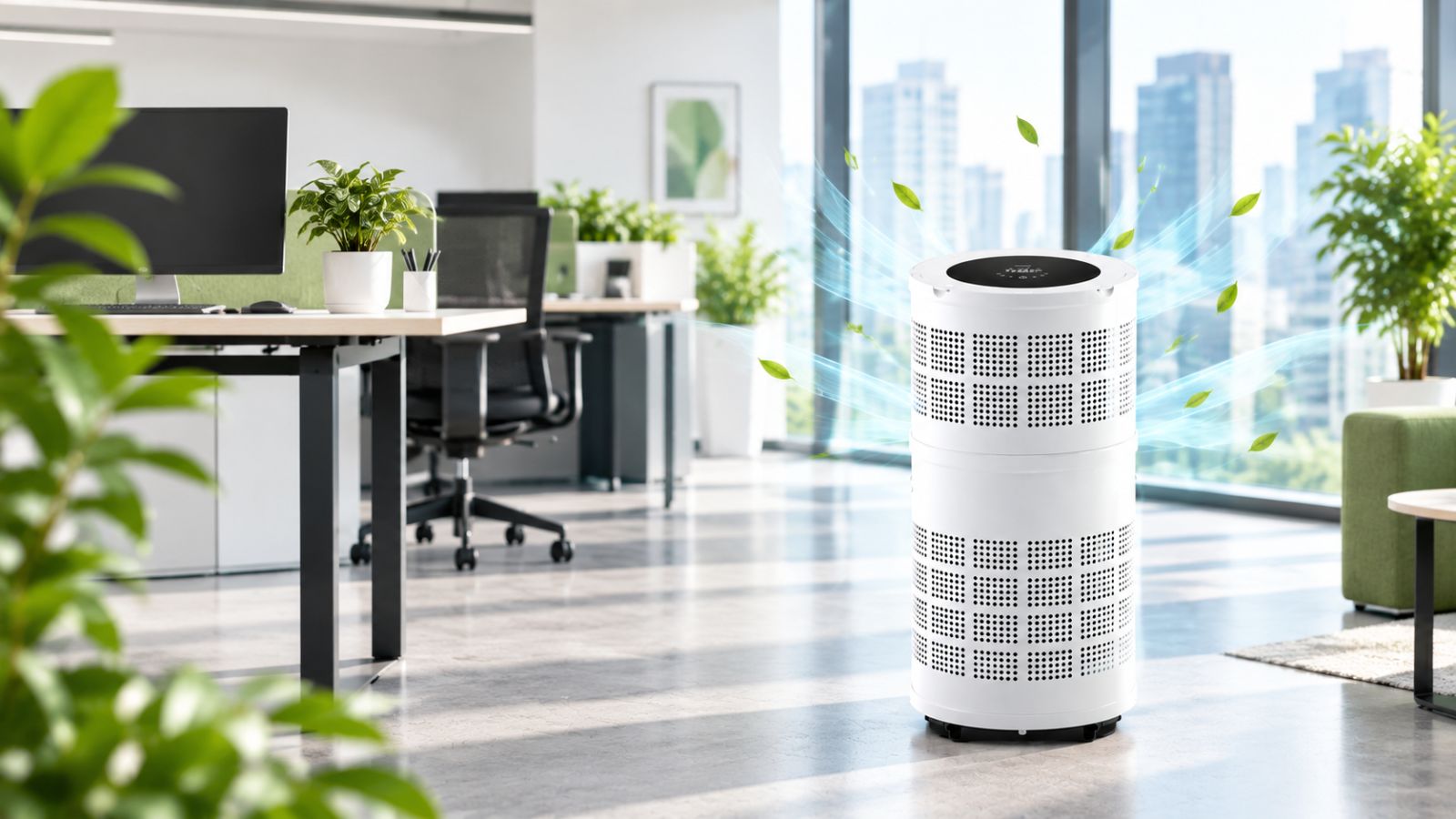
The best air purifier for office spaces should provide sufficient airflow, effective filtration, low noise, and manageable maintenance for the size and occupancy of the workplace.
Small offices may need a single room purifier, while large open-plan offices may require multiple units or an HVAC-integrated air purification solution.
Before choosing a system, facility managers should assess the office size, indoor pollutants, existing ventilation, energy consumption and operating costs. This helps ensure effective air cleaning without adding unnecessary equipment or expenses.
What Makes an Air Purifier Suitable for an Office?
An office air purifier should provide sufficient airflow, effective filtration and suitable coverage for the working environment. A unit designed for a small room may not have enough capacity to serve a busy meeting room or large open-plan office.
Facility managers should consider the following factors before choosing a system.
Coverage and sizing
Check the manufacturer’s recommended coverage area and compare it with the office size and ceiling height. Consider the total room volume and the required air-cleaning rate when selecting a unit.
Large open-plan offices may require multiple air purifiers positioned across the space, while smaller enclosed rooms may need only one unit.
CADR and airflow
Clean Air Delivery Rate (CADR) measures how quickly an air purifier delivers filtered air, accounting for both airflow and particle-removal performance.
Airflow, measured in cubic metres per hour (m³/h), refers to the volume of air passing through the unit over a given period.
Both measurements help facility managers assess whether a purifier can provide the required level of air cleaning.
Filtration
Look at the type and efficiency of filtration. HEPA filters are designed to remove very small airborne particles, while activated carbon filters can help reduce certain gases and odours.
The right filtration depends on the pollutants present in the building.
Noise
Office equipment should not interfere with conversations, meetings, video calls or concentration.
Check noise levels at the operating speed you expect to use rather than relying only on the lowest noise figure.
Energy use
Office air purifiers may operate for many hours each day. Energy consumption therefore matters when calculating ongoing building operating costs.
Controls
Consider whether the purifier has manual controls, remote management, automatic operation or centralised controls. These features can make it easier for facilities teams to manage multiple units.
Maintenance
Check how often filters need to be replaced, how easy they are to access and whether the system provides filter or maintenance alerts.
Types of Office Air Purification
Different office environments need different approaches. A small private office does not require the same type of system as a large open-plan floor.
Desk and small-room air purifiers
A desk air purifier for office use is designed for a small area around a workstation. Similarly, a mini air purifier for office spaces may be suitable for a small enclosed room.
However, facility managers should check the unit’s airflow rather than assuming a small purifier can clean an entire office.
Room-based air purifiers
Room-based systems are suitable for enclosed areas such as:
- Private offices
- Meeting rooms
- Reception areas
- Break rooms
- Training rooms
The unit should be sized according to the room volume and required air-cleaning rate.
Large-space air purifiers
Large commercial spaces may require higher-capacity air purifiers or several units working together.
This can be useful in open-plan offices where there is a larger air volume and more occupants.
HVAC-integrated air purification
Air purification can also be incorporated into an existing HVAC strategy. This can provide filtration through the building’s air-handling system rather than relying entirely on standalone units.
Smart air purification systems
Smart systems can provide information about indoor air conditions and system performance. For facilities teams, this can make it easier to identify areas that need attention and manage equipment across a building.
How to Choose an Office Air Purifier
Choosing an office air purifier also requires understanding the building’s occupancy, indoor pollutants and existing ventilation. Consider these factors before making a purchase.
1. Occupancy
The number of people using the space matters. A meeting room with 15 people has different requirements from a private office occupied by one person.
Higher occupancy can also increase the need for effective ventilation.
2. Pollutants
Identify what you are trying to control.
For example:
- Dust and fine particles
- Pollen
- Smoke particles
- Airborne biological particles
- Odours
- Certain VOCs
This helps determine which filtration technologies are appropriate.
3. Existing HVAC
Check the building’s existing ventilation and filtration before purchasing standalone units.
The aim should be to create a complete IAQ strategy rather than adding air purifiers without considering the existing system.
HEPA Air Purifiers for Offices
A HEPA air purifier for office environments can provide additional filtration of airborne particles.
HEPA filters are designed to capture very small particles from air. The CDC recommends portable HEPA air cleaners as one option for improving air cleanliness in indoor spaces.
They can be particularly useful in:
- Meeting rooms
- High-occupancy areas
- Private offices
- Areas requiring additional particle filtration
- Spaces where improving central HVAC filtration is difficult
However, HEPA filtration has limitations.
A HEPA filter primarily targets particles. It does not provide fresh outdoor air, so it should not be considered a replacement for adequate ventilation.
For this reason, facility managers should consider ventilation, HVAC filtration and supplementary air purification together.
What Facility Managers Should Compare
Before buying an air purifier for office environments, compare the following specifications:
| Factor | What to check | Why it matters |
| Airflow | Air volume in m³/h | Shows how much air passes through the unit |
| Filtration | HEPA, carbon and other filters | Helps match filtration to pollutants |
| Coverage | Recommended room size | Helps with correct sizing |
| Noise | dB at different speeds | Important for working environments |
| Energy | Power consumption | Affects ongoing running costs |
| Maintenance | Filter life and replacement | Helps plan servicing |
| Controls | Manual, remote or central | Makes management easier |
| Monitoring | IAQ and system data | Supports ongoing building management |
| Placement | Air intake and outlet design | Affects air circulation |
| Scalability | Ability to deploy multiple units | Useful for larger offices |
The cheapest unit is not necessarily the most cost-effective option. A purifier with insufficient airflow may require more units to achieve the required level of air cleaning.
Rensair Office Air Purification Solutions
Choosing an office air purifier is part of a wider indoor air quality strategy. The solution should work with your existing ventilation and HVAC systems.
Rensair offers commercial air purification solutions for offices and workplaces. Its Core i range combines H13 HEPA, UV-C and VOC filtration, with different airflow options for different spaces. Rensair Cloud also provides indoor air quality and system performance data.
For larger buildings, Rensair offers air purification solutions that can be integrated with existing HVAC systems to support building-wide air quality management.
Looking for the right solution for your office? Explore Rensair’s energy-efficient solutions or speak with our team.
Frequently Asked Questions
The best office air purifier should provide suitable airflow, effective filtration, low noise and enough capacity for the intended space.
Yes. HEPA filtration can provide additional removal of airborne particles and supplement existing office ventilation and HVAC filtration.
It depends on the space. Small purifiers can suit private offices but may not provide enough airflow for larger shared workspaces.
Desk purifiers can provide localised air cleaning, but they should not replace suitable ventilation or room-level air purification.
No. Air purifiers filter indoor air but do not replace the fresh outdoor air provided through suitable ventilation.
Standalone air purifiers can provide additional room-level filtration, while HVAC-integrated solutions can support wider building-level air cleaning.