


The Air Inside Your Senior Living Facility Is Affecting Your Bottom Line

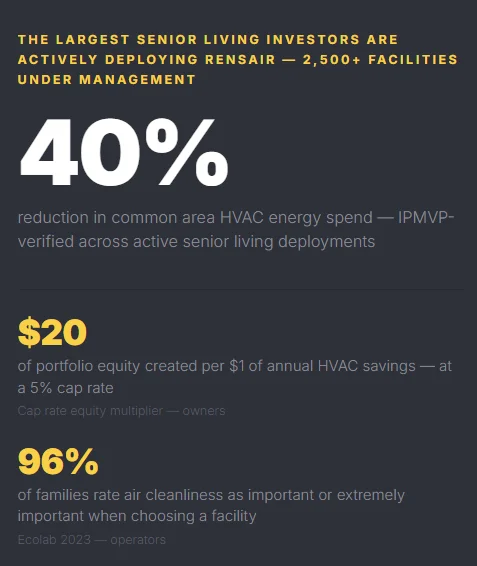
Resident health and portfolio performance are not competing priorities-they’re connected. Rensair delivers hospital-grade indoor air quality and a validated 40% reduction in HVAC energy spend. Healthier residents stay longer. Cleaner air converts more tours. And every dollar of energy savings compounds through the cap rate into portfolio equity.
Which Describes You?
Rensair serves two distinct stakeholders in senior living — each with a different business case.
Tell us which describes you and we’ll show you your specific ROI.
For Senior Living Owners

Portfolio Equity Creation + HVAC Energy Savings
Rensair delivers a validated 40% reduction in common area HVAC energy spend – without replacing your existing systems. For REITs operating under RIDEA, that saving capitalises through your cap rate into significant equity value. with active deployments across senior living portfolios already generating returns.
- 40% reduction in common area HVAC energy spend — validated
- 24% avg IRR · 38% case study high — IPMVP-verified
- $80M+ in portfolio equity value from NOI improvement at scale
For Senior Living Operators
Occupancy Revenue + Infection Control
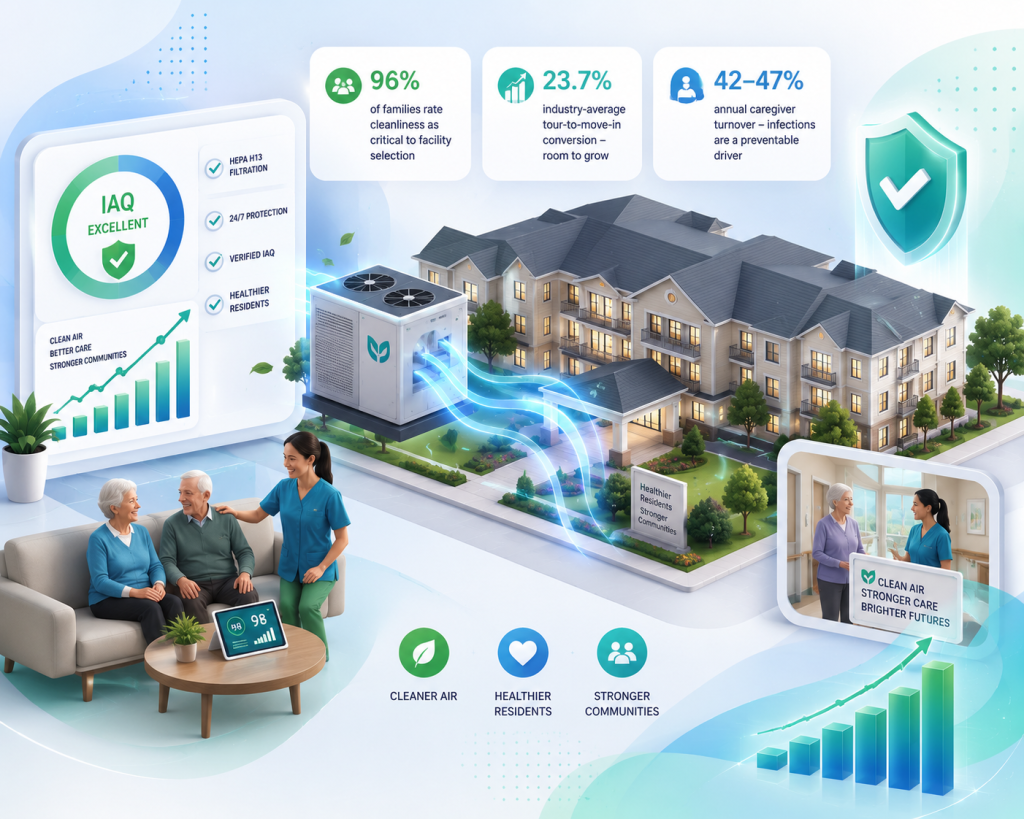
25% of all senior living online reviews cite cleanliness and odors. 96% of families say it’s ‘important or extremely important’ when choosing a community. Rensair addresses both — verified IAQ you can show families during tours, and continuous HEPA H13 filtration that reduces airborne infections 24/7.
- 96% of families rate cleanliness as critical to facility selection
- 23.7% industry-average tour-to-move-in conversion — room to grow
- 42–47% annual caregiver turnover — infections are a preventable driver
Balancing Care, Comfort and Cost

The Challenge
Senior living operators are navigating a uniquely complex environment: higher resident health needs, shared spaces, ageing HVAC infrastructure, and rising energy costs all at once. Many respond by increasing outdoor air ventilation. It’s well-intentioned – but it often comes at a price.

The Hidden Cost of More Ventilation
- Higher energy usage and rising utility costs
- Increased wear on ageing HVAC systems
- Limited control over actual air quality
- Reduced comfort when outdoor air quality is poor
More ventilation doesn’t always mean cleaner air — especially when outdoor conditions are poor or systems lack proper filtration.

The Difficult Trade-Off
For many operators it can feel like a choice between:
Prioritising resident health & safety or Maintaining financial & operational efficiency.
In today’s senior living environments, this shouldn’t have to be a trade-off. Clean air, resident wellbeing, and operational efficiency should go hand in hand.
The Technology
What Makes Rensair Different
Standard HVAC systems were built for airflow and temperature — not air quality. Demand Control Ventilation (DCV) uses CO₂ as a ventilation trigger, but CO₂ reflects occupancy, not what people are breathing. PM2.5, VOCs, and humidity are what actually determine air quality — and standard systems don’t measure them. Rensair is a Smart Demand Control Ventilation (SDCV) system: it measures all of it in real time and controls air quality at the source. Validated in hospital operating rooms, NHS care settings, and the world’s largest senior living portfolio.

Hospital-grade Filtration
HEPA H13 – The Hospital Operating Room Standard
Most senior living facilities run consumer-grade HVAC filters. HEPA H13 is what hospital operating rooms use — capturing 99.95% of particles ≥0.2μm including fine particulate matter, allergens, and airborne viral particles. Validated by the Danish Technological Institute and IndoorScience (US independent lab). Non-negotiable when 68% of your residents have existing respiratory conditions.

Neutralise Pathogen
Germicidal UVC – Continuous, Not Between Visits
Surface UV systems clean rooms between occupancies. Rensair’s germicidal UVC works on circulating air — neutralizing airborne bacteria and viruses 24/7, with residents in the room. A persistent layer of pathogen protection that works alongside your clinical infection control team.

SDCV Intelligence
Real-Time Intelligence – Air Quality and Cost, Measured and Managed
Standard DCV systems measure CO₂ — a proxy for occupancy, not air quality. Rensair SDCV continuously monitors PM2.5, VOCs, temperature, and humidity: the indicators that determine what residents are actually breathing. That real-time data drives smarter HVAC operation — cleaner air and lower energy spend from the same system. Every reading is logged, timestamped, and shareable via Rensair Cloud. Show a family live air quality data during a tour. Most of your competitors can’t.
Resident & Staff Impact
What Cleaner Air Means for the People Inside
Rensair was designed for hospital operating rooms. In senior living, it delivers the same standard of air quality – with measurable outcomes for residents, staff, and families.
+61%

Improvement in cognitive performance
Harvard research links clean indoor air to significantly better cognitive function — relevant for residents and for the care staff making health decisions throughout the day.
99.97%

Pathogen capture – Hospital OR standards
68% of senior living residents have existing respiratory conditions. HEPA H13 removes airborne particulate, allergens, and viral particles — continuously, with residents in the room. HEPA + UVC 24/7.
>50%
Particulate Matter reduction
PM2.5 reduction within one hour — when outdoor PM2.5 exceeded 100 μg/m³
Wildfire & Other Pollution Events
During the June 2025 Canadian wildfire event, outdoor PM2.5 across the Midwest exceeded 100 μg/m³. At a Rensair-equipped 158-unit senior living community, indoor PM2.5 was maintained at 0–10 μg/m³ during active hours — a greater than 50% reduction achieved within the first hour of activation.
When units were off overnight, indoor PM2.5 rose rapidly toward outdoor levels. When active: residents were protected. Every reading is timestamped in Rensair Cloud — auditable by families, boards, and insurers.



Certifications & Independent Validation
Independently Tested.
Professionally Verified.
Independent testing by world-leading laboratories demonstrates Rensair’s performance across four key areas: air filtration effectiveness, full-room air circulation, real-world versus laboratory data match, and safety & compliance.

NHS Liverpool
Rensair passed the Liverpool Biovalidation Protocol — a standardised testing regime developed jointly by the NHS England Chief Scientific Officer, NHS Innovation Agency, and the Office for Life Sciences to determine effective airborne pathogen reduction. November 2022.
NHS England · NHS Innovation Agency · Office for Life Sciences

Danish
Technological
Institute
HEPA H13 + UVC performance independently tested and certified by Teknologisk Institut — verifying 99.97% pathogen capture at the rated flow rate. The same filtration standard used in hospital operating rooms, now certified for commercial environments.
99.97% Pathogen Capture — Certified

IPMVP
M&V Protocol
Energy savings verified using IPMVP — the International Performance Measurement and Verification Protocol. The standard used by hospitals, utilities, and institutional investors to verify energy performance for capital deployment and ESG reporting decisions.
Investor-Grade Energy Verification Standard
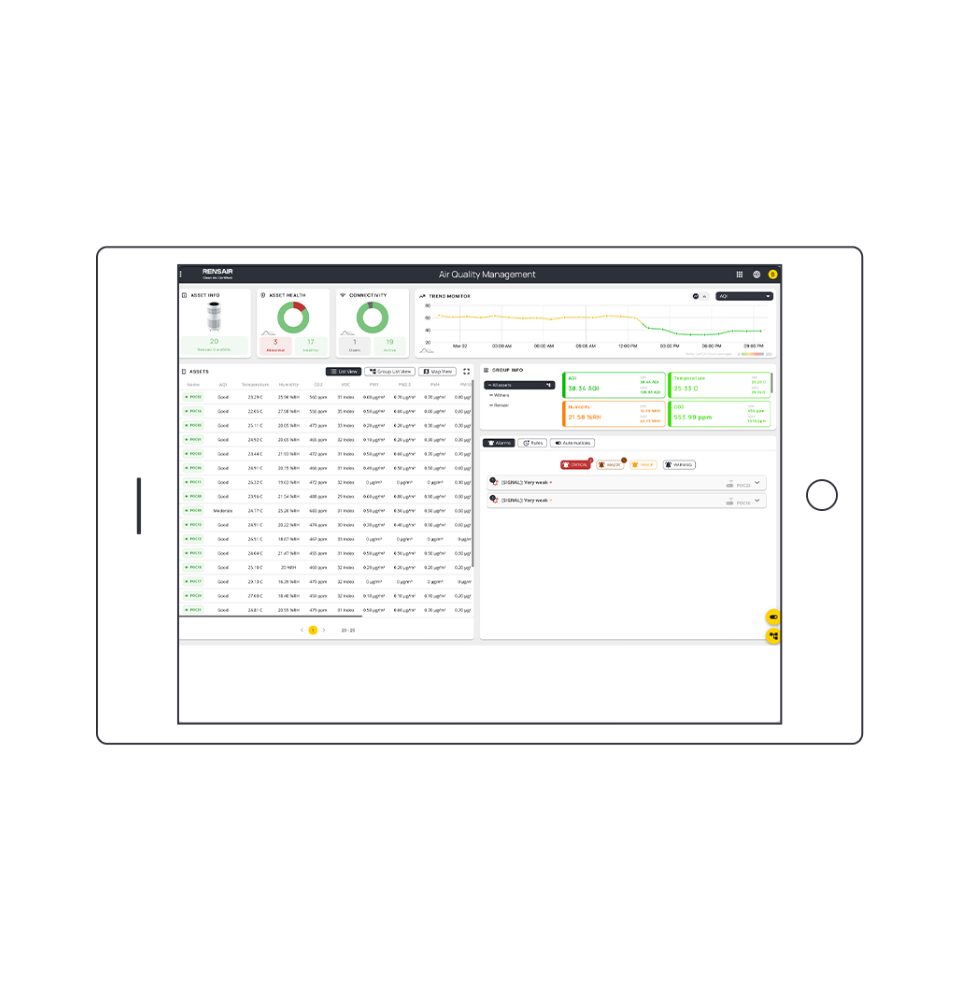
The most efficient way to instantly improve your HVAC system
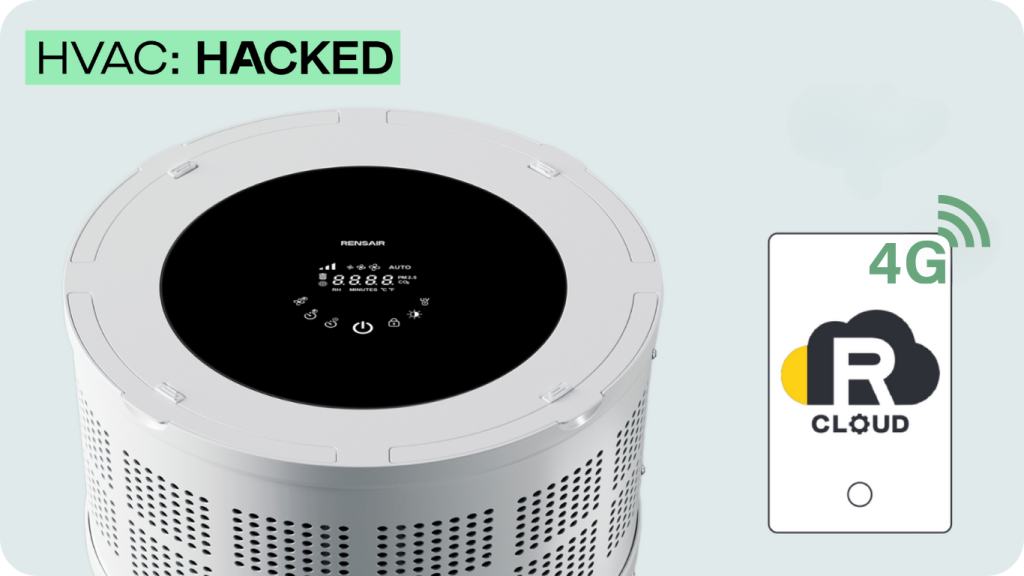
The Rensair Cloud connects your Rensair air purifying devices and integrates with your existing HVAC ventilation and Building Management systems to give you a single connected ecosystem for managing air quality. It’s an approach that reduces your energy usage, saves you money, and protects your people in every indoor space. It’s HVAC: Hacked.
Fast, Low-Risk Implementation
From First Conversation to Live IAQ Data in 90 Days
The Pilot Guarantee
Risk-free.
By design.
The 3-building pilot is IPMVP-verified — an independent measurement protocol that confirms your actual energy savings before any portfolio decision is made. Rensair guarantees a minimum return that fully de-risks the investment. If documented savings don’t reach the agreed threshold, Rensair continues working at no additional cost until they do. You’re not evaluating Rensair on faith. You’re evaluating it on verified numbers.
Every pilot delivers measurably cleaner air. The only decision left is how fast to scale.
What Senior Living Teams Ask Us
Does Rensair replace our existing HVAC system?
No. Rensair works alongside your existing HVAC and ventilation infrastructure. There is no construction, no system replacement, and no facilities overhaul. Installation takes under 1 day per facility.
How do REIT owners see the financial returns?
Rensair delivers a validated 40% reduction in common area HVAC energy spend. For REITs under RIDEA, this improvement in NOI capitalises through the cap rate into portfolio equity value. At a 5% cap rate, $1M in annual savings = $20M in equity.
Can we show families the air quality data?
Yes – this is one of Rensair’s most powerful sales tools for operators. The Rensair Cloud dashboard shows live PM2.5, VOC, and temperature readings. During a tour, you can show families real, timestamped data. 96% of families say cleanliness is ‘extremely important’ when choosing a community (Ecolab).
What does the pilot process look like?
It starts with a free site visit — no commitment. Rensair assesses your common areas, maps unit placement, and gives you a baseline IAQ read. From approval to live Rensair Cloud data typically takes under 90 days.50
What does Rensair do for resident health outcomes?
Harvard research links cleaner indoor air to up to +61% improvement in cognitive performance. For senior living residents — 68% of whom have existing respiratory conditions — HEPA H13 filtration removes airborne particulate, allergens, and viral particles that standard HVAC systems don’t address. Rensair’s UVC layer also neutralises airborne bacteria and viruses continuously, with residents in the room, 24/7
How does Rensair protect residents during wildfire smoke events?
During the June 2025 Canadian wildfire event, outdoor PM2.5 across the Midwest exceeded 100 μg/m³. At a Rensair-equipped 158-unit senior living community, indoor PM2.5 was maintained at 0–10 μg/m³ during active hours — a greater than 50% reduction achieved within the first hour of activation. Rensair Cloud logs every reading with timestamps, giving operators auditable evidence of air quality for families and insurers.